
PNG Destiny Party Leader and Wau Waria’s first Member of Parliament, Hon Marsh Narewec, has again brought together local and international experts, government agencies and development partners, this time to begin laying the groundwork to revive the historic multi-million kina Garaina Tea Plantation.
Within just five year of his first term as the district MP, Hon Narewec has pushed the long-dormant plantation back into development discussions, with the aim of transforming it into a commercially viable industry capable of generating millions of kina, creating economic opportunities for local communities and contributing to Papua New Guinea’s agriculture sector.
The expert advisers, drawn from the government, the private sector and specialist fields, bring extensive experience to help the district develop a clear credible pathway towards rehabilitating the plantation, to commercial and international standards.
“We are fortunate to have an international tea specialist, Gayal Perera coming all the way from Sri Lanka as an Ecometric Limited partner to join us. Gayal specialises in facilitating the entire process of taking the tea from the soil right up to the shelves,” Hon Narewec announced.
“We also have expert advisers from the Department of National Planning and Monitoring, the Department of Agriculture and Livestock, the Morobe Provincial Administration, the Morobe Provincial Health Authority, the Lutheran University of Papua New Guinea, the Seventh-day Adventist Church and our key district officers together in one room.”
“The purpose is to present, brainstorm, share constructive ideas and agree on how, as stakeholders we can partner to get this important project off the ground.”
GARAINA TEA HAS PREMIUM QUALITY MARKET POTENTIAL
Having personally visited Garaina twice already in the recent weeks to inspect the plantation site, the international tea specialist, Gayal Perera said the proposed 400-hectare state land has the potential to produce an estimated 600 to 620 metric tonnes of tea annually.
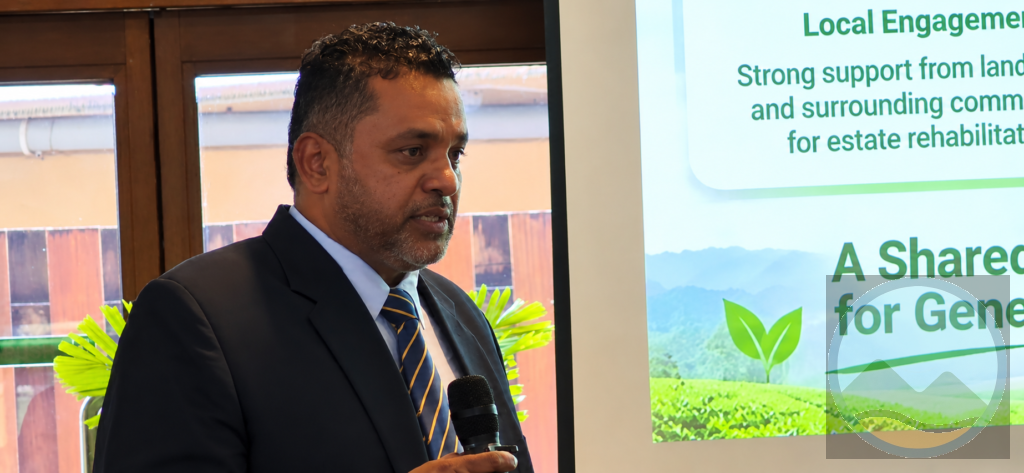
International Tea Specialist, Gayal Perera presenting findings from his recent visits to the abandoned Garaina tea plantation.
“The estimated long-term tea production potential is about 600 to 620 tonnes per year. From inspecting the tea currently growing as shrubs and among the trees, Garaina tea is of premium quality. It has the potential to compete on the world market, and Garaina provides highly suitable growing conditions,” Perera said.
Wilco Liebregts, a monitoring and evaluation expert attached to the Department of National Planning and Monitoring (DNPM), said production at that scale could potentially generate millions of kina annually.
Liebregts, who was involved in drafting the Medium Term Development Plan 4 (MTDP4), in which Garaina Tea was featured, estimated that 600 tonnes of premium-quality tea produced from 400 hectares could generate between K20 million and K30 million annually, depending on market prices.
“Six hundred tonnes of premium-quality tea grown on 400 hectares could bring in around K20 million to K30 million a year, based on the lows and highs in prices but the nucleus estate has to be commercially viable and profitable, so that it can stand on its own feet,” he said.
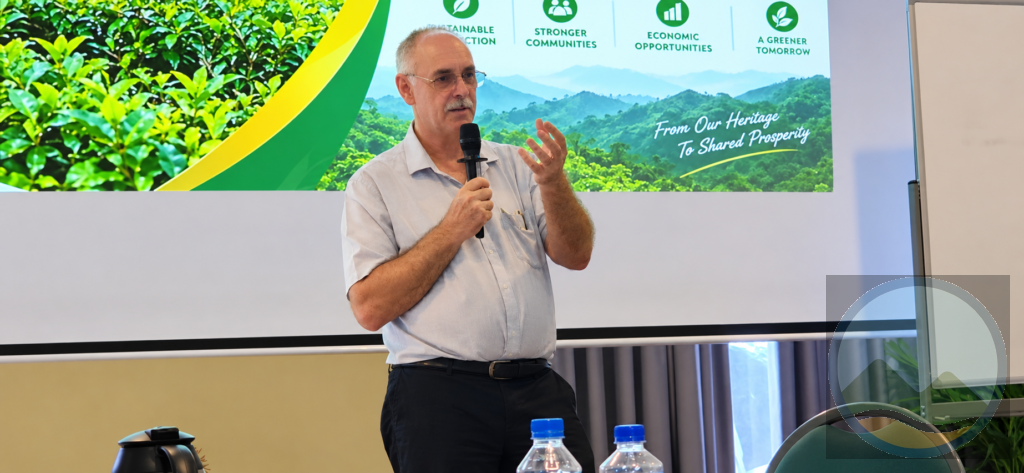
Wilco Liebregts, expert adviser attached to the DNPM, now advising Wau Waria DDA as a key stakeholder to revive Garaina Tea.
Liebregts also referred to an Asian Development Bank (ADB) study that assessed small and medium enterprises considered worthy of support, saying Garaina tea was highly regarded in that assessment.
COUNTERPART FUNDING CRITICAL
After listening to presentations from the experts, Hon. Narewec said that while previous assessments had identified that the lack of road access is a major obstacle, counterpart funding would be critical if the project is to move beyond planning and into implementation.
“The World Bank and donor partners may come with funding, but they will require counterpart funding from us, the stakeholders and main beneficiaries of this project. We cannot entirely depend on development partners to fund everything,” he said.
Hon. Narewec stressed that all parties must demonstrate genuine commitment if they want to make history in reviving the long-dormant plantation.
He called on the Morobe Provincial Administration, DNPM, DAL, the district’s LLGs and other stakeholders to contribute according to their respective responsibilities, saying the Wau Waria DDA would use whatever capacity it has to get Phase One of the project underway.
“My DDA managed to reach Garaina on the 14th of September last year, two days before the country’s 50th Independence anniversary. Although the pilot track of the national Northern Highway is still under construction, Garaina has now been connected towards Wau and Lae. So now, let’s talk about Garaina Tea,” Hon Narewec stated.
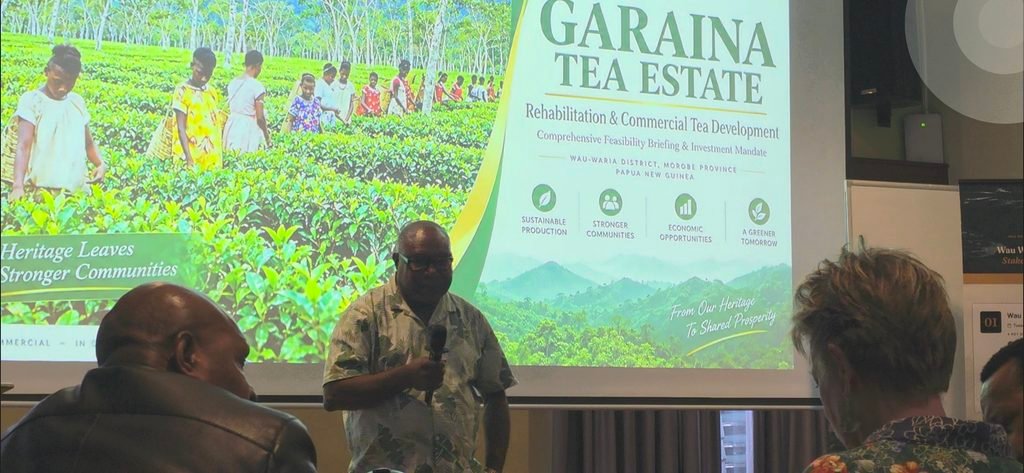
Wau Waria DDA Chief Executive Officer, John Orebut, a long time serving kiap at Garaina station shares history of the tea plantation.
He said improved road connectivity had opened an opportunity to seriously revisit an agricultural project whose potential had remained largely untapped for decades.
“The whole purpose of knocking on doors and bringing everyone together is to add value. This is a multi-million kina project, and we will be seeking major funding from the National Government and investors, alongside funding from the DDA,” he said.
PLANTATION ENVISIONED AS ECONOMIC CATALYST
Hon Narewec said bringing the stakeholders together was also important for establishing clear responsibilities and ensuring everyone involved had access to the same information as planning progresses.
“My vision is to use this plantation as a catalyst for consistent growth in business and services, and as a means of generating income for the people of Wau Waria, investors and the district. This project must have national significance and national output. It must contribute to Papua New Guinea’s development indicators in terms of tea production,” he said.
For Hon Narewec, the revival of Garaina Tea is also about establishing an economic foundation that can benefit future generations beyond the current political term.
“These things may not eventuate immediately while you and I are still around, but we must do it for our children and the generations to come. Let’s set the foundation now so that those who come after us can build on it, grow it and make it bigger,” he said.
Commending Hon Narewec’s initiative, the Department of Agriculture and Livestock’s Policy and Dialogue Adviser, Robyn Ekstrom said, DAL was pleased to be part of the collaborative effort.
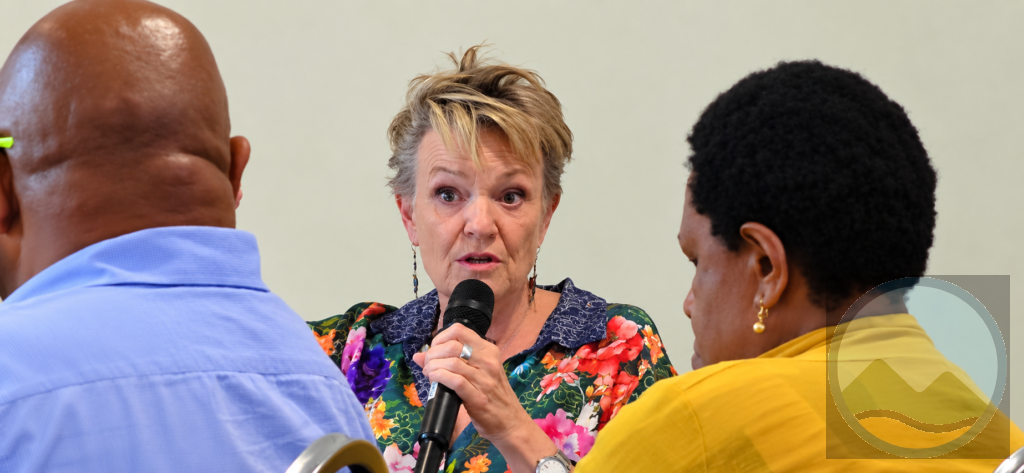
Robyn Ekstrom, expert adviser with DAL pledging full support to Wau Waria DDA revive Garaina Tea.
She said the department is prepared to provide support and work alongside Hon Narewec and the Wau Waria DDA, as efforts to revive the Garaina Tea Project progress.